Isoceles Triangle When You Know the Base
 Download Article
Download Article
An isosceles triangle is a triangle with two sides of the aforementioned length. These two equal sides ever bring together at the same angle to the base (the third side), and come across directly to a higher place the midpoint of the base of operations.[one] Yous tin can test this yourself with a ruler and two pencils of equal length: if yous endeavour to tilt the triangle to one direction or the other, you cannot get the tips of the pencils to see. These special backdrop of the isosceles triangle let you lot to calculate the area from just a couple pieces of information.
-
1
Review the area of a parallelogram. Squares and rectangles are parallelograms, as is any four-sided shape with two sets of parallel sides. All parallelograms have a simple expanse formula: area equals base multiplied by the height, or A = bh.[ii] If y'all place the parallelogram flat on a horizontal surface, the base is the length of the side it is continuing on. The superlative (as yous would look) is how high it is off the ground: the distance from the base to the opposite side. Always measure the superlative at a right (ninety caste) bending to the base.
- In squares and rectangles, the height is equal to the length of a vertical side, since these sides are at a right angle to the ground.
-
2
Compare triangles and parallelograms. There's a simple relationship betwixt these two shapes. Cutting whatever parallelogram in half along the diagonal, and it splits into two equal triangles. Similarly, if you lot accept two identical triangles, you can always tape them together to make a parallelogram. This means that the area of any triangle can be written as A = ½bh, exactly half the size of a corresponding parallelogram.[3]
Ad
-
3
Find the isosceles triangle's base. Now you have the formula, simply what exactly exercise "base" and "height" mean in an isosceles triangle? The base is the easy part: simply use the third, unequal side of the isosceles.
- For example, if your isosceles triangle has sides of v centimeters, v cm, and half dozen cm, employ 6 cm equally the base.
- If your triangle has iii equal sides (equilateral), you lot tin can pick any one to be the base of operations. An equilateral triangle is a special type of isosceles, simply you tin find its surface area the same style.[iv]
-
4
Draw a line between the base to the contrary vertex. Make sure the line hits the base of operations at a right angle. The length of this line is the pinnacle of your triangle, so label information technology h. In one case you calculate the value of h, y'all'll be able to detect the surface area.
- In an isosceles triangle, this line will always striking the base at its exact midpoint.[5]
-
v
Look at one half of your isosceles triangle. Notice that the height line divided your isosceles triangle into 2 identical right triangles. Look at one of them and identify the 3 sides:
- 1 of the short sides is equal to one-half the base: .
- The other curt side is the height, h.
- The hypotenuse of the right triangle is ane of the two equal sides of the isosceles. Permit'southward phone call information technology s.
-
6
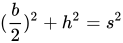
Ready the Pythagorean Theorem . Any time yous know 2 sides of a right triangle and desire to find the third, you lot can use the Pythagorean theorem:[6] (side i)2 + (side two)2 = (hypotenuse)2 Substitute the variables we're using for this problem to go .
- You probably learned the Pythagorean Theorem as . Writing information technology every bit "sides" and "hypotenuse" prevents confusion with your triangle'due south variables.
-
seven
Solve for h. Retrieve, the area formula uses b and h, merely you don't know the value of h yet. Rearrange the formula to solve for h:
-
viii
Plug in the values for your triangle to find h. Now that you know this formula, you tin can use it for any isosceles triangle where you lot know the sides. Just plug in the length of the base of operations for b and the length of one of the equal sides for due south, then calculate the value of h.
-
9
Plug the base and summit into your area formula. Now you have what you lot demand to use the formula from the start of this section: Surface area = ½bh. Just plug the values you found for b and h into this formula and calculate the reply. Think to write your respond in terms of foursquare units.
- To continue the example, the 5-5-half-dozen triangle had a base of half dozen cm and a height of 4 cm.
- A = ½bh
A = ½(6cm)(4cm)
A = 12cmtwo.
-
10
Try a more difficult instance. Most isosceles triangles are more difficult to work with than the last example. The pinnacle frequently contains a square root that doesn't simplify to an integer. If this happens, get out the height as a square root in simplest form. Here'south an instance:
Advertisement


-
1
Get-go with a side and an angle. If you know some trigonometry, you tin can find the surface area of an isosceles triangle even if you lot don't know the length of one of its side. Here's an example problem where you only know the following:[7]
- The length s of the two equal sides is 10 cm.
- The bending θ between the two equal sides is 120 degrees.
-
ii
Split up the isosceles into ii right triangles. Draw a line down from the vertex betwixt the two equal sides, that hits the base at a right angle. You lot now take two equal right triangles.
- This line divides θ perfectly in half. Each right triangle has an angle of ½θ, or in this instance (½)(120) = 60 degrees.
-
iii
Use trigonometry to notice the value of h. Now that you have a right triangle, you tin use the trigonometric functions sine, cosine, and tangent. In the example problem, you know the hypotenuse, and you lot desire to find the value of h, the side adjacent to the known angle. Use the fact that cosine = adjacent / hypotenuse to solve for h:
- cos(θ/two) = h / south
- cos(60º) = h / 10
- h = 10cos(60º)
-
4
Notice the value of the remaining side. There is one remaining unknown side of the right triangle, which yous can phone call x. Solve for this using the definition sine = opposite / hypotenuse:
- sin(θ/2) = x / south
- sin(60º) = x / ten
- x = 10sin(60º)
-
v
Relate x to the base of operations of the isosceles triangle. You lot can now "zoom out" to the main isosceles triangle. Its total base b is equal to 210, since it was divided into two segments each with a length of x.
-
6
Plug your values for h and b into the basic area formula. Now that yous know the base and tiptop, you tin rely on the standard formula A = ½bh:
-
7
Plow this into a universal formula. Now that you know how this is solved, you can rely on the full general formula without going through the full procedure every fourth dimension. Here's what you lot end up with if you repeat this procedure without using whatsoever specific values (and simplifying using properties of trigonometry):[8]
- s is the length of one of the two equal sides.
- θ is the bending between the two equal sides.
Advertisement

Add New Question
-
Question
How tin can I find the side of an isosceles triangle when simply the area and the length of equal sides are given?

A=area, 50=length of 1 equal side, b=base, θ=HALF of angle between two equal sides. Dissever the triangle in half downwards the heart. The middle line is h, the height. Analyze the left triangle, where Fifty is the hypotenuse and the smallest angle is θ. The smallest side is b/2, and the concluding side is h. sinθ = (b/ii) / Fifty --> b/2 = Lsinθ. cosθ = h/L --> h = Lcosθ. A = (1/2)bh = (b/2)h = (Lsinθ)(Lcosθ)=(50^ii)sinθcosθ. sin(2θ) = 2sinθcosθ (past trig identities) --> sinθcosθ = (one/two)sin(2θ). --> A = (L^2)sinθcosθ = (1/two)(L^two)sin(2θ). Because A and L are known, the higher up equation tin can be used to find sin(2θ). Arcsin of sin(2θ) gives 2θ, assuasive y'all to find θ. And then, y'all can observe b from the equation: b/2 = Lsinθ.
-
Question
How tin can I show that a triangle is isoceles?

Coordinate proof: Given the coordinates of the triangle'south vertices, to prove that a triangle is isosceles plot the 3 points (optional). Apply the distance formula to calculate the side length of each side of the triangle. If any ii sides take equal side lengths, so the triangle is isosceles.
-
Question
How do I find the base of operations of a triangle if there is no superlative and no expanse?

You don't. You lot must be given certain information: perimeter, other sides, surface area, or acme.
-
Question
What will be the area of an isosceles triangle with a perimeter of 42m and a base of 20m?
Let each of the 2 equal sides of the triangle be x meters.So, the perimeter is 2x + 20 = 42. So ten = xi. The surface area of the triangle is then 1/2*20*root(11^2 - x^2) = 10root(21)
-
Question
How exercise I find the area of an Isosceles triangle whose ane side is 10 cm greater than its two other equal sides, with a perimeter of 100 cm?
Use the perimeter to find the sides of the triangle (3x + 10 = 100). Then apply half the largest side and one of the equal sides to detect the height through the Pythagorean Theorem. Finally, use the newly plant height and the largest side of the triangle every bit its base of operations in the formula to find a triangle's area.
-
Question
How practise I discover the area of an isosceles triangle when given two sides?
If you are told the length of the base (unequal side), and then you know the other two sides are equal, so yous know all 3 side lengths and can use the standard method. If yous only know the lengths of the ii equal sides, then you cannot find the area without more information (such as the perimeter or an angle).
-
Question
How practise I find the area of an isosceles triangle if the base is 10 cm and elevation is 8 cm?
The expanse of a triangle is the base times height divided by two (bh/two). Just plug in the numbers: (10)(8)/2 = 80/ii = 40. The area of your triangle is forty cm².
-
Question
How do I find the area and perimeter of an isosceles right angled triangle?
In an isosceles right triangle, the two equal sides have a right bending between them. This means you can use one equal side as the base of operations, and the other as the height. If these sides have length s, so the area is (i/2)s^ii. To detect the perimeter, use the Pythagorean theorem to detect the length of the hypotenuse, and add together it to the lengths of the other sides.
-
Question
The base of an isosceles triangle is 5cm and the length of each equal side is denoted by south. Ho do I limited the perimeter of this triangle in terms of s?
The perimeter is equal to the sum of all side lengths. Since there are two sides with length due south, the perimeter of this triangle is five + s + south, which simplifies to 2s + 5 cm.
-
Question
If a triangle has equal 60 degree angles, what is the value of angle A?

Onebluethinker
Community Respond
Since the angles of a triangle add up to 180 degrees, you tin can notice the answer by adding the two known angles (60 and 60) and subtracting that total from 180. In this instance, 60 plus lx equals 120, and 180 minus 120 equals 60, so the third angle is also 60 degrees.


Show more answers
Ask a Question
200 characters left
Include your email accost to get a message when this question is answered.
Submit
Advertizement
Video
-
If you have an isosceles correct triangle (two equal sides and a 90 degree angle), it is much easier to detect the area. If you use one of the short sides as the base, the other curt side is the height.[9] Now the formula A = ½ b * h simplifies to ½stwo, where south is the length of a brusk side.
-
Square roots have two solutions, ane positive and i negative, but yous can ignore the negative one in geometry. You cannot accept a triangle with "negative peak," for example.
-
Some trigonometry problems might give you other starting data, such every bit the base of operations length and i angle (and the fact that the triangle is isosceles). The basic strategy is the aforementioned: separate the isosceles into correct triangles and solve for the pinnacle using trigonometric functions.
Thanks for submitting a tip for review!
Advertizement
Most This Article
Article Summary X
To find the area of an isosceles triangle using the lengths of the sides, label the lengths of each side, the base, and the height if it's provided. Then, utilize the equation Surface area = ½ base times height to find the surface area. If the length of the height isn't provided, divide the triangle into 2 correct triangles, and use the pythagorean theorem to find the tiptop. Once y'all have the value of the height, plug information technology into the area equation, and label your respond with the proper units. For more tips, similar how to employ trigonometry to find the area, keep reading!
Did this summary aid you?
Thanks to all authors for creating a folio that has been read 622,474 times.
Did this commodity assist yous?
Source: https://www.wikihow.com/Find-the-Area-of-an-Isosceles-Triangle
0 Response to "Isoceles Triangle When You Know the Base"
Postar um comentário