Pure Tube Stereo Amplifier With Bluetooth Line and Phono Inputs Review

The Monoprice Pure Tube Stereo Amplifier is available for the paltry sum of $359.

Before reading any other part of this review, contemplate that first sentence once more. This all-tube integrated amplifier costs less than a fancy pair of interconnects or speaker wires. And it includes a phono input. If you're 1 of the young "vinylistas" for whom your turntable is your totem, this could be the amplifier for You!
The Monoprice Pure Tube Stereo Amplifier offers an introduction to truthful tube audio for a ridiculously low toll. The styling is both retro and futuristic, and in that vein, includes retro inputs (phono and line-stage) and futuristic ones (Bluetooth wireless). Simply one does give up a few amenities like remote book command, a headphone jack, and a thorough owners' manual. It'due south still a bully deal, just for only a chip more money, it could take been untouchable!
Highlights
Monoprice Pure Tube Stereo Amplifier
- Striking styling
- x Watts per channel is enough to drive near loudspeakers
- Can be used every bit a tube preamplifier merely
- Onboard Bluetooth allows streaming from APTX devices
- Moving-magnet phono input
- Induced hum can be a problem unless precautions are taken
- Miserly price makes this one of the least expensive tube integrated amps available
Introduction
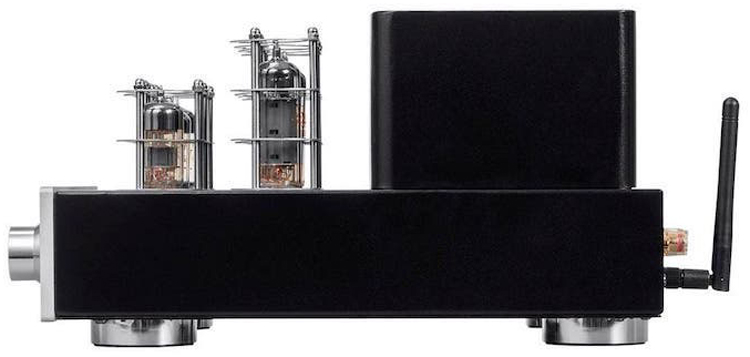
Equally to the Monoprice Pure Tube Stereo Amplifier (henceforth the "MP"), let's dispel the biggest misconception kickoff: I can simply hear the voices of the unwashed mob screaming "ONLY 10 WATTS?!?" Yes, it truly has simply 10 watts-per-channel output. And even that is measured simply at 1KHz, not 20-20kHz.
But do you Actually need more? The average loudspeaker sold in 2020 is highly sensitive (normally from 90 to 94dB / 1W/1m). Now get out your cell phone, download a free sound pressure level app, sit in your listening chair, and kickoff cranking upward the music. Yeah, that's it – crank information technology up some more. Beginning to get uncomfortably loud, yes? Now y'all're budgeted 90-ish decibels. THAT'due south the volume yous get from Ane watt. More loudness increases the wattage demands very apace, but for virtually listeners, the first watt lonely will suffice, and the remaining nine will hands handle any unexpected crescendos.
The MP will, absolutely, not play at stadium levels. Merely if you lot're listening at those levels, sound quality is bookish anyway because you'll soon be deafened. The MP will play loud enough for your habitation just fine. The occasional raucous holiday party excepted; 10 watts will get you where you need to be. Period.
So, explain to me again why you demand that gazillion-watt AVR that sounds like badly wounded cats fighting?
The Monoprice Pure Tube Stereo Amplifier is built in China and sold by the ubiquitous Monoprice.com here in the The states. It seems of sturdy construction for the most part, and mine was easy to use.
MONOPRICE PURE TUBE STEREO AMPLIFIER SPECIFICATIONS
MODEL:
Pure Tube Stereo Amplifier, Product #27222
INPUTS:
Bluetooth (BT), Line-Level (Aux), & Phono-Level (Phono)
FREQUENCY RESPONSE:
20Hz – 20kHz (-2dB)
TOTAL HARMONIC DISTORTION:
1% @ 1kHz
RMS POWER OUTPUT:
10 Watts / aqueduct (four-ohm load @ 1kHz)
OUTPUT IMPEDANCE RANGE:
four – 8 ohms
INPUT IMPEDANCE:
47k ohms
Signal TO Dissonance RATIO:
≥ 85dB
TREBLE ADJUSTMENT RANGE:
+6dB
BASS ADJUSTMENT RANGE:
+6dB
INPUT VOLTAGE:
100-120 VAC @ 60Hz
FUSE RATINGS:
T2AL @ 125V
TUBE TYPES:
EL84 (iv) & 6N3 (3)
BLUETOOTH VERSION:
4.0 with aptX audio codec
BLUETOOTH RANGE:
32ft (10m)
BLUETOOTH ID
MP TUBE 27222
DIMENSIONS:
10.7 x v.9 x 12.4in (272 x 150 ten 315mm)
SECRETS Tags:
pure tube stereo amplifier, vacuum tube, integrated amplifier, budget component, depression power, Monoprice, Amplifier Review 2020
Linkbacks
- Sound Research tube DAC-ix
- Audio Enquiry VT80SE tube power amplifier
- Vincent Sound hybrid power amplifier & preamplifier
- Bluish Aura V30 Desktop Tube Amplifier
- Vacuum Tube Sound M125 monophonic power amplifiers
Design & Setup
The setup of the MP is easy, just the owners' manual contains at least one error and omits at least one important circumspection.
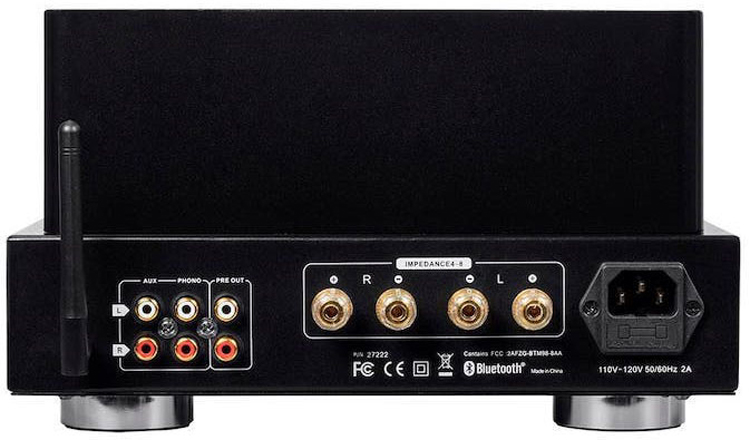
The owners' manual conspicuously states:
"The output level of the PRE-OUT jacks is unaffected by the volume knob."
This is incorrect. On both my review sample and at to the lowest degree one other unit owned past an online amigo, the pre-out jacks are volume controlled. This allows the use of the MP as a standalone tube preamplifier or allows the user to drive one or more subwoofers from the pre-out jacks.
However, the volume bachelor on the pre-out jacks may be insufficient to bulldoze some amplifiers (mostly pro amps that need more input voltage) to full volumes. This should not impede the average user, but a potential purchaser should exist enlightened of it.
Another important factoid not mentioned in the owners' transmission is that those pre-out jacks are full-range and that the speaker outputs are also full-range, regardless of whether subwoofer(s) are used with the main speakers. This means that in that location will exist no way to eliminate bass frequencies from the satellite speakers (or the amplifier's output tubes) despite having subwoofer(s) on the pre-out jacks.
The owners' manual too clearly states:
"Do not turn on the amplifier without commencement connecting a pair of 4-8-ohm speakers."
This is true insofar as it goes, but fails to address the situation where an owner wants to utilise the MP equally a tubed preamplifier just. If the pre-out jacks are being used to drive an external power amplifier, there may not be any speakers continued to the MP's terminals. This is a problem and could feasibly atomic number 82 to damage of the MP.
If the owner wishes to use the MP as a preamp only (and without attached speakers), then a dummy load must be connected to each pair of speaker terminals. A single 10-ohm, 10 Watt resistor (available via Amazon – yous'll need two – one for each channel) should be connected across each pair of speaker terminals (ruby to blackness for each channel) to avoid harm to the EL-84 output tubes. When speakers are reconnected to the MP, remove the dummy resistors.
The MP provides three modes of input –
- Auxiliary (typically used with CD players, streamers, tuners or other line-level analog sources)
- Phono (typically used with raw moving-magnet phono cartridges – no upstream RIAA equalization or line-level converters, delight)
- Bluetooth (via supplied antenna)
I used the Auxiliary and Bluetooth inputs and and then loaned the MP to an audio amigo, Mr. David Sonnier, for testing with his phonograph. I was specially satisfied with the ease of setting up the Bluetooth. With my cell telephone, I was streaming in minutes.
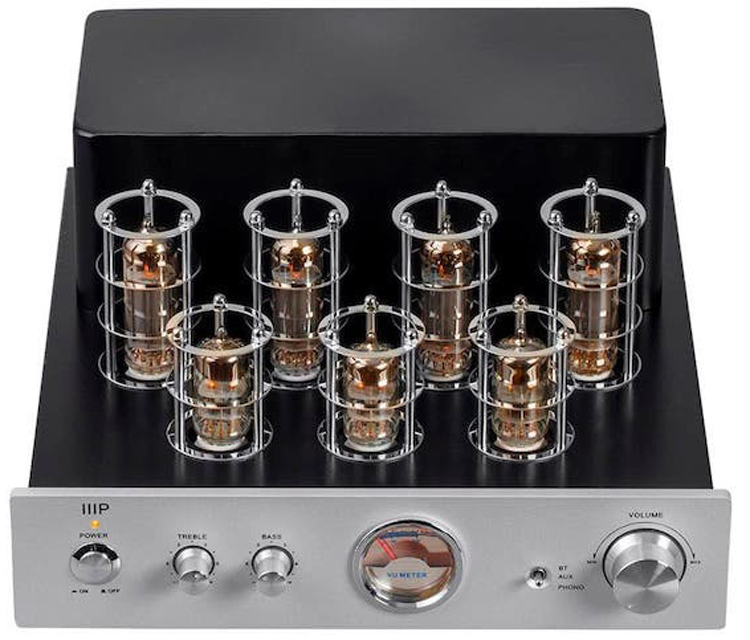
The front panel of the MP includes a VU meter that I consider a total waste of money on this product. I would much rather have seen Monoprice include whatever or all of the following:
- A remote control with volume
- A headphone jack
- A built-in USB DAC
- A cutoff switch to protect the output tubes when the MP is used as a preamp only
But it is what it is. If any of these omissions is a bargain-breaker for you lot (some are for me), and then you'll need to spend more than money on another production. The VU meter, past the way, was working when I received the review amplifier simply stopped working during the grade of the review.
These missing features are not niggling. Since at that place is no remote volume control, I would normally consider this amp to be a headphone amplifier for a computer system (where the listener would be in close proximity to the amplifier's volume knob at all times), but the amp has no headphone jack. Of course, one could manage via some adapters to connect headphones to the MP's speaker terminals, merely the MP's output transformers are intended to bulldoze low impedance loads (4-viii ohms). With college impedance headphones, who knows how this would audio?
So, if you lot want to use this amplifier in a living room system, plan on getting up to adjust the volume knob routinely. If yous're listening to vinyl, a single adjustment at the beginning of each disc side may be sufficient, only if y'all're streaming digital, different cuts often have WILDLY different volumes, significant that you may exist rushing from your listening position to the amplifier very often to adjust the volume. This lonely, unfortunately, disqualifies the amplifier for use in many people's listening rooms.
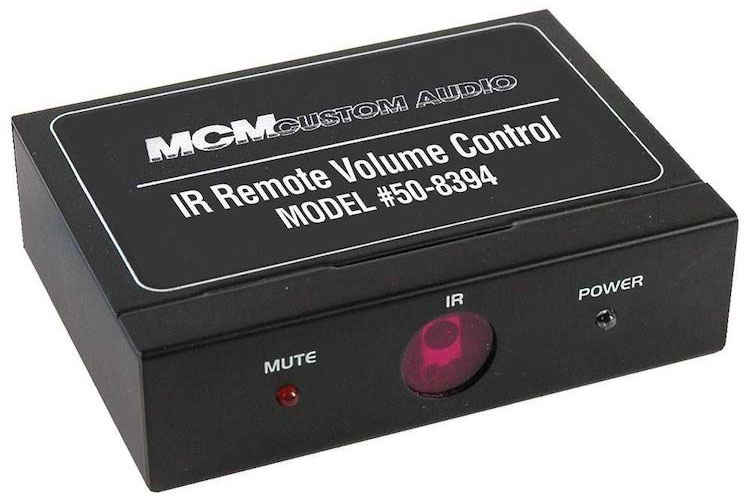
Even so, there is an later-market place device that might let remote control volume for an additional $39.99. That would exist the MCM Custom Audio fifty-8394 Line Level Volume Control with IR Remote. Although this would work But with the Aux input of the MP (or in the pre-out section if the MP was used every bit a preamp merely), it would permit for remote volume control, and with pretty expert sound. This unit is available from Amazon.
Associated Equipment Used in this Review:
- MacBook Pro running Roon streaming software over Ethernet to
- AURALiC Aries Ethernet streamer using the coaxial digital output to
- Blackness Ice Audio FX Tube DAC (review to come) to
- Audio-gd Vacuum XLR tube preamp
- Audio-gd HE-i solid-state preamp
- MCM 50-8394 remote book control
- Emotiva PA-1 monoblock amplifiers
- Heathkit 12W amplifiers
- Ashly FTX-2001 pro power amp
- Emotiva T2 tower loudspeakers
- Klipsch RP600M bookshelf speakers
- Klipsch Cornwall IV speakers
- Emotiva Airmotiv S-fifteen subwoofers
- Emotiva / Audioquest / Afford-HiFi interconnects
- Carnare speaker wire (bi-wire configuration)
In Use
My equipment rack has a broad variety of transformers and badly tangled wires behind it. When the single-concluded RCA interconnects on the inputs of the Monoprice Pure Tube Stereo Amplifier come up anywhere close to this rat's nest of transformers and wires, induced hum becomes audible at the speakers. And so, nosotros'll have hum, hum, hum till her daddy takes the tube amp away! (With apologies to the Embankment Boys).
Careful dressing of interconnects will eliminate virtually of the hum, only fifty-fifty and so, and with the shortest possible cable lengths, a slight bit of hum seems likely. With nigh speakers, this volition be inaudible, just with ultra-loftier sensitivity models similar the Klipsch Cornwall IVs, you may have to work with amplifier placement to avoid audible hum.
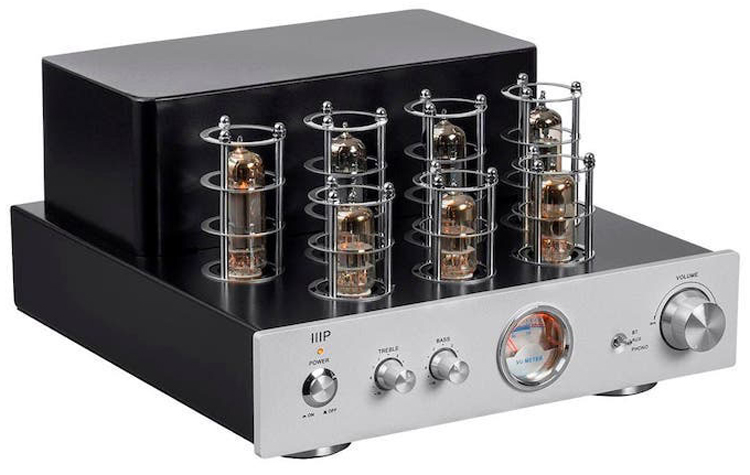
The MP likewise sports bass and treble controls with a total 12-decibel range (plus and minus 6dB for both bass and treble). On near systems, I'thousand a fan of tone controls, but on this particular amplifier, I sincerely believe the tone controls may crusade more issues than they fix. The treble controls are probably benign since nearly users don't add much boost or cut. But the bass control has the potential to be actually problematic. If any meaning bass boost is practical, the amp'due south 10-watt power capacity will be quickly exceeded causing audible clipping.
Despite this, the tube output stage of the MP is far less likely to cause speaker damage than any solid-state amplifier in similar clipping manner. Solid-country clipping tin rapidly fry tweeters. But it is nevertheless a expert thought to use the bass boost of the MP in very pocket-sized doses (no more than plus 1 or one.5dB) and to avoid cranking upwardly the book significantly while the bass is boosted.
Then… How does the Monoprice Pure Tube Stereo Amplifier sound?
In the treble, it's just slightly rolled-off but not besides blurred – very much like a traditional tube amplifier (think Dynaco Stereo 70, for example). For many of today's speakers, this volition not exist an impediment, simply a blessing. The forgiving treble will also make many an otherwise harsh piece of music more listenable. Information technology volition also hibernate a multitude of Bluetooth sins, and make wireless streaming a more pleasurable experience. It does non sound as extended in high-frequency response as many contemporary tube amplifiers, but again – this tin can oftentimes be complementary to many sources.
In the midrange, the MP amplifier comes into its ain! Yes, the MP is slightly warm and sweet and yep, it may too slightly exaggerate spatial and imaging clues in the music, but overall, the effects are almost positive. If y'all've never heard a tube component before, this would be an ideal one to effort. If you like the tube effects, you tin can move up, and if not, you haven't actually wasted your money.
In the bass, the MP amplifier is less than tight and tends to slightly mistiness bass lines. If you're a rock music fan, you may never even notice these issues (after all, I'm comparison this modestly priced amplifier confronting a reference arrangement where cost was of little concern). Merely if you mind to classical or jazz music, the bass may be more troublesome for yous. Because of its output transformer, the MP has a relatively low damping factor (meaning that it may non command the woofer cones as tightly equally would a solid-state amplifier that lacks the output coupling transformer).
Now if I've given the impression that I don't like the sound of the Monoprice Pure Tube Stereo Amplifier, I repent. Despite its sonic shortcomings detailed to a higher place, the sound can be captivating, entrancing, and heady. This will be more and so with some program materials than others, but at its best, the MP sounds like a FAR more than expensive amplifier! The MP can sound like real music where many (most?) other (solid-country) amplifiers in its cost range fall far, far short. This amp will easily trounce many AV receivers that I've heard.
Phono Input Impressions of the Monoprice Pure Tube Stereo Amplifier by David Sonnier
Since my review system is totally digital, I loaned the MP to an audio amigo for testing of its phono input. The following comments are generously provided past Mr. David Sonnier who tested the review unit with his vinyl system):
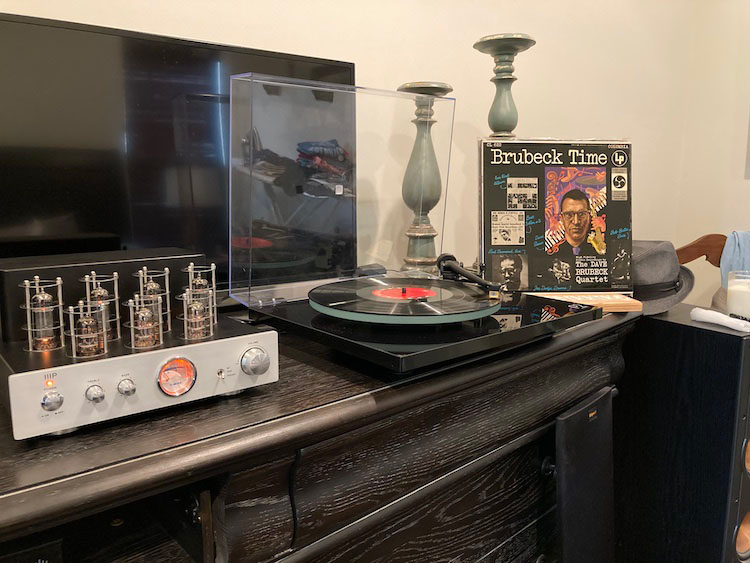
This amplifier tin can drive the Klipsch RF62ii speakers with ease and sounds good while doing it. The bass on M'Boom really hits hard. I'm amazed at how little power 1 needs to have swell sound. The Monoprice Pure Tube Stereo Amplifier is a nice-sounding little integrated amp. I'1000 blown abroad at how powerful 10wpc can audio, especially through floor-standing speakers.

The Dave Brubeck Quartet "Brubeck Time"
I'thousand playing an erstwhile mono LP from 1955 chosen "Brubeck Time," an original pressing – and it sounds Dainty!

Steely Dan "Gaucho"
Steely Dan'due south "Gaucho" sounds awesome through this amplifier.

Wayne Shorter "Etcetera"
Wayne Shorter's tremendous sounding jazz LP from Blue Note, "Etcetera" (Blue Note 80th anniversary Tone Poet reissue series) brings on the details. Horns sound fantastic through this amplifier, and it sounds overnice at low volumes too.
A remote would exist overnice, but at times I felt similar I was correct there with the band, surrounded past musicians. This amplifier was also auditioned with the Pro-Ject Tube Box phono phase (through the AUX input). The Tube Box sounds ameliorate than the built-in phono preamp in the Monoprice, only for the coin, it should!
Monoprice Pure Tube Stereo Amplifier Aux and Bluetooth Inputs Review by Glenn Young

Parov Stelar "The Demon Diaries"
"The Demon Diaries" by Parov Stelar is a bit of a disappointment compared to the ring's live performances on YouTube, but still offers an interesting mix of contumely and synth. I do wish that the ring would offering their YouTube performances in Blu-ray or 4K video with at least CD-quality audio. I'd buy those discs! But I digress…
Even listening at somewhat louder than normal volumes, the MP handled this textile with ataraxy. I'd expected to hear some clipping in the bass, just no – the 10 watts of the MP was enough to rock the room when playing my tower speakers total-range.
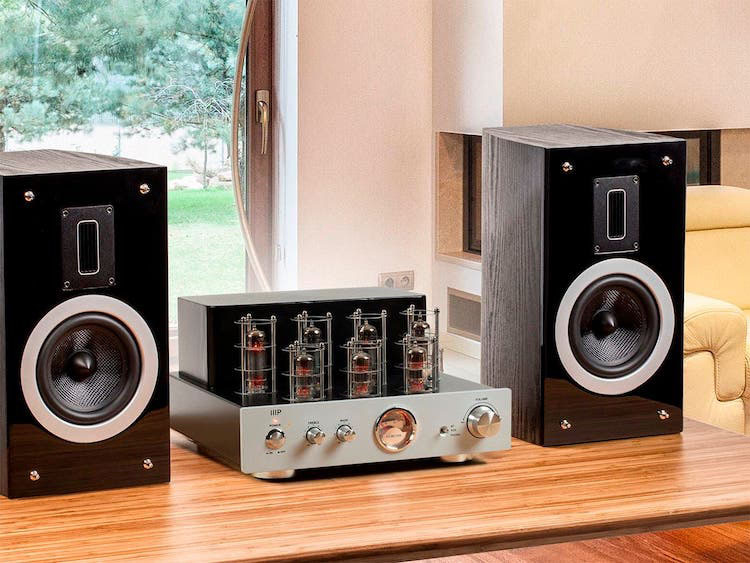
Out of curiosity, I did claw up subwoofers to the pre-out jacks of the MP for part of this ii-disc set, and everything worked perfectly. The MP played my speakers through its speaker terminals, and the subs kept up through the pre-out jacks. Wonderful!

The Pentangle "Handbasket of Light"
Side by side up was the Pentangle's archetype alive album "Basket of Light," streamed through the Bluetooth antenna of the MP. The string bass can be wooly on this album, but the voices should be lovely. The harmonies and vocal rounds used by the Pentangle have never sounded better in my system than with this amp. A couple of previous equipment configurations have tied the performance of this amplifier for midrange beauty and imaging, but none has startlingly exceeded the MP's functioning.
When we (over again) consider its modest $359 list price, I don't see how any other production could possibly lucifer the value for the money it exhibits. What a bargain!
Conclusions
The MONOPRICE PURE TUBE STEREO AMPLIFIER offers unique and amazing value for its small price. Despite its lack of a remote, it is HIGHLY recommended!
Likes
- Sugariness and dimensional midrange
- Born phono section
- Bluetooth streaming with easy setup
- Compact and stylish advent
- Tone controls included
Would Like To See
- Remote volume control
- Headphone jack
- More restricted range of boost for the bass tone command
- Switch to disable output tubes when the unit of measurement is used as a preamp only
- More thorough and authentic owners' transmission
For the tube-curious and those on entry-level budgets, I know of NO other all-tube integrated amplifier for anywhere NEAR the bargain toll of the Monoprice Pure Tube Stereo Amplifier. If you're willing to alive inside its 10-watt limitations, and particularly if you're a "vinylista" who needs a phono stage, I don't think yous can do ameliorate (in an all-tube design) than this amplifier.
Besides, if you decide that y'all need more power later, you can notwithstanding use the MP as a tubed preamplifier (with Bluetooth and Phono Stage), and employ the pre-out jacks to drive the power amplifier of your option. Put the MCM 50-8394 remote volume control between the pre-out jacks of the MP and the power amplifier of your choice, and you lot now go all the benefits plus remote volume control as well!
Source: https://hometheaterhifi.com/reviews/amplifier/integrated-amplifiers/monoprice-pure-tube-stereo-amplifier-review/
0 Response to "Pure Tube Stereo Amplifier With Bluetooth Line and Phono Inputs Review"
Postar um comentário